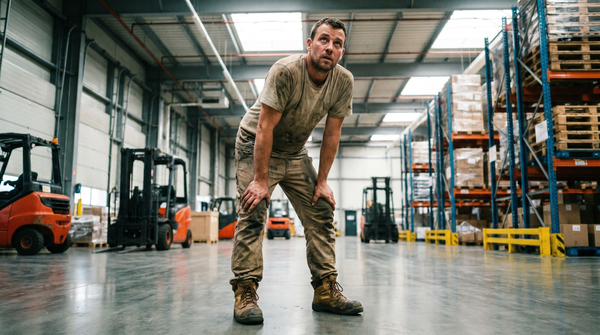
By hour nine on a concrete slab, your feet aren't just tired — they're wrecked. Heels that feel like someone's taken a hammer to them. Knees that click going up stairs. A lower back that's been screaming since lunch. Most guys blame the job. The real problem is sitting right inside their boot: a flat piece of foam that cost the manufacturer forty cents and hasn't been swapped out since last winter. Here's what you actually need to know — what works, what's a waste of money, and what keeps you standing at the end of a full shift.
14 min read · Updated 2026-05-06
- The stock insole in your work boot is not designed to support you — it fills space and gives the shoe a finished feel in the store. It bottoms out within weeks of heavy use, at which point you're walking directly on the boot's midsole.
- Foot pain is a kinetic chain problem, not just a foot problem: arch collapse creates tibial rotation at the knee, which creates pelvic tilt, which increases lumbar loading. The back pain you've been ignoring often starts six feet lower.
- The right insole depends on your arch type, your surface, and your trade — not just the brand. A roofer's needs are completely different from a welder's or a warehouse picker's.
- At $24.50, a quality insole costs $0.15 per hour of a 10-hour shift — less than a gas station coffee per week — versus $200–$800 for custom orthotics and $17,000+ for the average workers' comp foot injury claim.
Why Work Boots Destroy Your Feet (It's Not the Boots)
Good work boots — real ones, from brands that actually know the trade — are built tough. Steel or composite toes. Oil-resistant outsoles. Waterproof uppers. They're designed for the job. What they're almost never designed for is the insole sitting inside them.
Factory insoles are a cost item. They're there to fill the boot interior and make it feel finished on the store shelf. They are not built to support an arch under 200 lbs of body weight plus tools, moving across concrete for ten hours straight. Most of them compress to less than 3mm of effective cushion within two to three weeks of heavy use. At that point, you're walking directly on the boot's midsole. Might as well be wearing slippers.
The Kinetic Chain: Why Your Back Hurts When Your Feet Are the Problem
Here's what most people miss: foot pain during a shift is rarely just a foot problem. Every step on a hard surface sends a shockwave straight up your body. When the insole can't absorb that impact — and the arch can't distribute it — the force travels up the kinetic chain:
- Arch collapse at the foot → internal rotation of the tibia
- Tibial rotation → knee adduction (knees rolling inward)
- Knee adduction → anterior pelvic tilt
- Pelvic tilt → increased lumbar loading (lower back compression)
Clinical research published in the National Institutes of Health's database backs up what workers feel every day: insoles reduce low back pain in workers who stand or walk on hard surfaces for extended periods. That back pain you've been blaming on your age or your posture? A significant chunk of it starts at your feet.
Concrete specifically makes it worse. Ergonomics researchers have found that prolonged standing on concrete slab is biomechanically equivalent to carrying an extra 12 lbs. Your feet are absorbing force loads they were never built to handle, hour after hour, with nothing underneath them worth calling cushion.

The Stock Insole Problem
Pull the insole out of your work boot right now. Press your thumb into the heel zone. If you feel the hard base of the boot within 2–3mm, the insole is dead. Not worn. Dead. It's giving you almost nothing. The cover fabric usually looks fine — that's the last thing to go — but the foam underneath has already packed down to near zero.
This is where most workers are after a season in the same boots. The boots are fine. The insole gave up months ago.
How to Choose the Right Insole Before You Buy
The biggest mistake is grabbing whatever's on sale or whatever has the most reviews without matching it to your arch type and what your job actually puts you through. A high-arch insole on a flat foot causes more pain than no insole at all. Get the match right first.
Step 1: Identify Your Arch Type
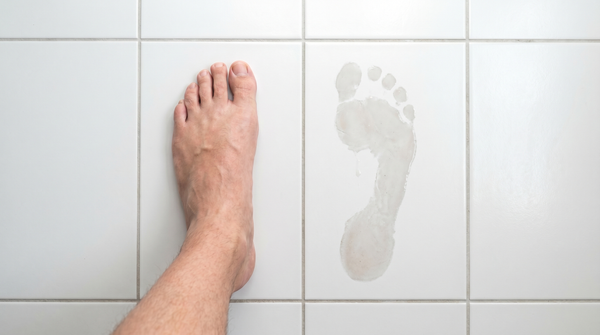
The wet test is the fastest way. Wet the bottom of your foot, step on a piece of cardboard or a brown paper bag, and look at the print:
- Flat foot (low arch): Almost the entire sole makes contact. You'll see a nearly complete footprint with little or no curve on the inner edge. Flat feet overpronate — the ankle rolls inward — which drives the whole kinetic chain problem described above. You need a firm, supportive arch to control that motion.
- Neutral arch: A moderate curve on the inner edge, roughly half the foot visible. Most people land here. You've got the most flexibility in insole choice — semi-rigid support is usually the sweet spot.
- High arch: A thin strip on the outer edge with a big gap in the middle. High arches supinate (roll outward) and don't absorb shock well because the arch doesn't flex during impact. You need cushioning-forward insoles with flexible arch support. Rigid correction will make things worse.

Step 2: Identify Your Primary Problem
Different insoles fix different things. Match to your actual pain point — not to the prettiest packaging:
- Plantar fasciitis (sharp heel pain, brutal on those first few steps out of bed): You need a deep heel cup plus firm arch support to take load off the plantar fascia. See the complete guide on insoles for plantar fasciitis.
- General fatigue and soreness (that dull ache that sets in around hour six): Cushioning-forward semi-rigid insole. Most common complaint, easiest fix.
- Ball-of-foot pain / metatarsalgia (burning or aching under the forefoot): Common in roofers, framers, anyone who crouches or kneels a lot. Look for a metatarsal pad or a cushioned forefoot zone.
- Ankle rolling or instability (especially common with flat feet): Deep heel cup plus medial arch post to control pronation.
- Knee or back pain that originates at the foot: Corrective arch support to break the kinetic chain. See the guide on insoles for knee pain from standing.
Step 3: Match to Your Work Surface
- Concrete slab: Maximum shock absorption is the priority. Dual-density foam or gel heel with firm arch support.
- Uneven terrain, scaffolding, or pitched roofs: Rigid or semi-rigid arch shell for lateral stability. Cushioning matters less than not rolling an ankle on a rafter.
- Mixed — in and out, pavement and grass, warehouse to loading dock: Semi-rigid hybrid insole handles the full range without giving up too much on either end.
What Features Actually Matter in a Work Boot Insole
Insole marketing is full of noise. Here's what actually moves the needle after eight hours of heavy use.
Heel Cup Depth — The Most Underrated Feature
The heel cup surrounds and supports the fat pad under your heel bone. A deep cup — 6–8mm or more — centers the heel, controls rearfoot motion, and stops the heel from splaying under load. Heel splay is one of the main drivers of plantar fasciitis, and most budget insoles do almost nothing to prevent it. When you're comparing insoles in the store, press your thumb into the heel zone. You should feel a distinct cup shape. If it feels flat, put it back.
Foam Density — What "Cushioning" Actually Means
Not all foam is the same. Low-density foam (under 35 kg/m³) feels great in the store and bottoms out within weeks. High-density foam (45+ kg/m³) is firmer, compresses proportionally under load, and holds its structure through 20,000+ steps. The cushion you feel at step one should still be meaningfully there at step 18,000. If an insole feels like it was cut from a cheap pool noodle, it's going to perform like one.
Arch Support Type
- Foam arch: Soft, flexible, comfort-first. Fine for neutral arches, but won't control overpronation under heavy use.
- Semi-rigid shell (EVA or polypropylene): The sweet spot for most trade workers. Actual motion control without the stiffness of a custom orthotic. Holds arch position under sustained load rather than collapsing with it.
- Rigid shell: Maximum correction. Useful for severe flat feet or pronounced pronation, but can be uncomfortable in boots where the foot is already tightly constrained.
Top Cover Material
In work boots, moisture management is not optional. A moisture-wicking, antimicrobial top layer stops the bacterial growth that causes odor and skin breakdown. After a 10-hour shift in leather or rubber boots, your feet have shed a significant amount of moisture into that insole. A cover that traps it turns into a real problem within weeks — anyone who's peeled out a two-month-old insole knows exactly what that smells like.
Profile and Thickness — Watch This With Steel-Toe Boots
Steel-toe and composite-toe boots have less interior volume than regular footwear. Add a thick insole and suddenly your toes are being compressed against the cap — which causes nail bruising and is far worse than no insole at all. For safety footwear, look for insoles designed for low-profile applications (under 6mm total height at the heel), or pull the factory insole out and replace it with something close to its original thickness.
Durability — When Does It Actually Need Replacing?
For workers doing 40+ hours a week on hard surfaces: every 3–6 months, not once a year. The foam loses structural integrity long before the cover shows any visible wear. Signs it's done: visible compression in the heel zone, the arch shape has flattened out, foot or back pain that improved after you got the insoles has gradually come back. That last one is the most reliable indicator.
Trade-by-Trade: What Works for Your Job
Every generic article on insoles treats all workers as one person who "stands all day." That's not how it works. The biomechanical demands of a roofer are completely different from a welder or an electrician. Here's what actually matters, broken down by trade.

Construction Laborers and Concrete Workers
Surface: poured concrete slab, most of the day. Step count: 8,000–14,000. Primary problem: cumulative heel and arch shock, lower back loading that builds hour by hour. What you need: maximum heel cushion (8mm+ depth), high-density foam, firm arch support. On concrete, every heel strike is a force spike. The insole takes that hit or your body does. There's no third option.
See also: best insoles for standing on concrete.
Electricians and Plumbers
Surface: mixed — concrete, crawlspaces, ladders. Step count: moderate, but with a lot of kneeling, crouching, and forefoot loading. Primary problem: metatarsal pain from repeatedly loading the forefoot while crouching and climbing. What you need: semi-rigid arch support plus a cushioned forefoot zone or metatarsal pad. Pure heel cushioning won't touch forefoot pressure from kneeling positions — ask any plumber who's tried.
Roofers and Framers
Surface: pitched roofs, uneven framing, scaffolding. Step count: variable. Primary problem: lateral ankle instability from angled and uneven surfaces, combined with forefoot pressure from toe-standing on pitched surfaces. What you need: a semi-rigid to rigid arch shell for lateral stability above everything else. On a pitched surface, your arch is constantly working just to keep your foot level. Without support, the peroneal tendons on the outer ankle fatigue fast — and a fatigued ankle on a roof is a serious problem.
Welders
Surface: concrete or metal grating, often stationary for long stretches. Step count: low, but static standing beats up your arches in ways people don't expect. Primary problem: arch fatigue from sustained isometric loading — the arch muscle group tires under static load even with a low step count. Heat is a real factor too; ambient temperatures near a welding setup will degrade cheaper insole materials faster than you'd think. What you need: firm arch support with a breathable, heat-resistant top cover. Static standing is often harder on arches than walking because there's no gait cycle giving the foot any break at all.
Warehouse and Manufacturing Workers
Surface: concrete or epoxy floors, 8–12 hours. Step count: 10,000–18,000+. Primary problem: cumulative shock across the full shift plus arch collapse from sustained overpronation at high step counts. Research shows roughly two-thirds of warehouse workers report lower extremity symptoms. What you need: the full package — deep heel cup, high-density foam, semi-rigid arch, moisture management. This is the highest-demand category, full stop.
See also: best insoles for warehouse workers.
Built for Workers. Tested Through Full Shifts.
KANEEA All-Day Comfort Insoles — 8mm PU memory foam heel cushion, 45+ kg/m³ density, semi-rigid arch support, trim-to-fit for any work boot or safety shoe. 946+ verified reviews. Free US shipping.
Order Now — $24.50A Note for Women in the Trades
Almost every insole review skips this entirely. Women make up a growing share of construction, manufacturing, and trade workers — and most insoles on the market were designed on male foot lasts. That gap matters for fit and performance.
Women's feet differ from men's in a few specific ways: narrower heel relative to forefoot width, higher arch frequency, and different metatarsal head positioning. An insole built on a male last will often sit loose at the heel and create pressure points at the forefoot in women's work boots. If insoles seem to slide around or feel off despite being the right size, that's almost always the reason.
What to look for: insoles that specifically offer women's sizing with a narrower heel zone, or trim-to-fit options that let you customize the heel width. KANEEA's trim-to-fit design accommodates both male and female foot geometry across EU 35–46. Trim from the toe only using the factory insole as a guide, and pay close attention to heel fit — it should seat flush with no gap between the insole edge and boot heel.
How to Install Insoles in Work Boots (Step-by-Step)
Done wrong, a new insole makes fit worse, not better. Here's how to do it right.
- Remove the factory insole first. Never stack insoles — you'll compress the boot interior and create pressure on the top of your foot within hours. The factory insole pulls out from the heel end. If it's glued down, use your fingernail to get under the edge and peel slowly. Rushing this tears the boot lining.
- Use the factory insole as your cutting template. Set the old insole on top of the new one, trace the outline in pen. This matches the shape to your specific boot, not some generic size that's close but not quite right.
- Trim from the toe only. Small cuts, work up to the line. Never trim the heel — the heel cup depth and geometry are built into the insole design. Cut the heel and you've destroyed the support structure you just paid for.
- Test with your actual work socks. Work socks are thicker than regular socks. Put on the boot with your normal work socks before you finalize the trim. The fit should be snug across the top of the foot, not tight.
- Break in over 2–3 days. Wear them for an hour or two on day one, half a shift on day two, full shift by day three. Your foot muscles need time to adapt to the new arch position. Going straight to a 10-hour shift on day one often produces arch soreness — which workers take as a sign the insole doesn't work. It's not. It's your foot adjusting to actual support for the first time in months.
Is It Worth the Money? The Math
Run the actual numbers and the decision gets straightforward fast.

A $24.50 insole worn 5 days a week in 10-hour shifts lasts roughly 4–5 months before needing replacement. That works out to:
- $4.90 per month of protection
- $0.15 per hour on a 10-hour shift
- Less than a gas station coffee per week
Compare that to the alternatives:
- A single podiatrist visit: $200–$400 before treatment even starts
- Custom orthotics: $200–$800, often not fully covered by insurance
- One lost workday from a foot injury: far more than $24.50 in wages alone
- Average workers' comp settlement for a foot injury: $17,000+
Your work boots cost $150–$250. The insole inside them cost the manufacturer about $0.40. For $24.50 — roughly one-tenth the price of the boots — you replace the one component that actually determines whether those boots feel tolerable or brutal by the end of a shift.
You can't afford not to have one. That's the short version.
$24.50. One Purchase. Months of Difference.
Join 946+ workers who made the switch to KANEEA. 30-day money-back guarantee. Free US shipping on all orders. Trim-to-fit for any work boot, clog, or safety shoe.
Get KANEEA InsolesWhen Insoles Aren't Enough — See a Podiatrist If...
A quality insole resolves or significantly reduces most fatigue-related and biomechanical foot pain within 2–4 weeks. If you've been using a proper insole consistently and still have these symptoms, get professional assessment:
- Pain persists or worsens after 4–6 weeks with proper insoles
- Numbness or tingling in the toes or top of the foot
- Sharp pain at rest or at night — not end-of-shift fatigue
- Visible deformity: bunion growth, hammer toes, or a heel spur you can actually feel
- Pain that is specifically worse after rest then improves with movement — classic plantar fasciitis that insoles alone may not resolve